
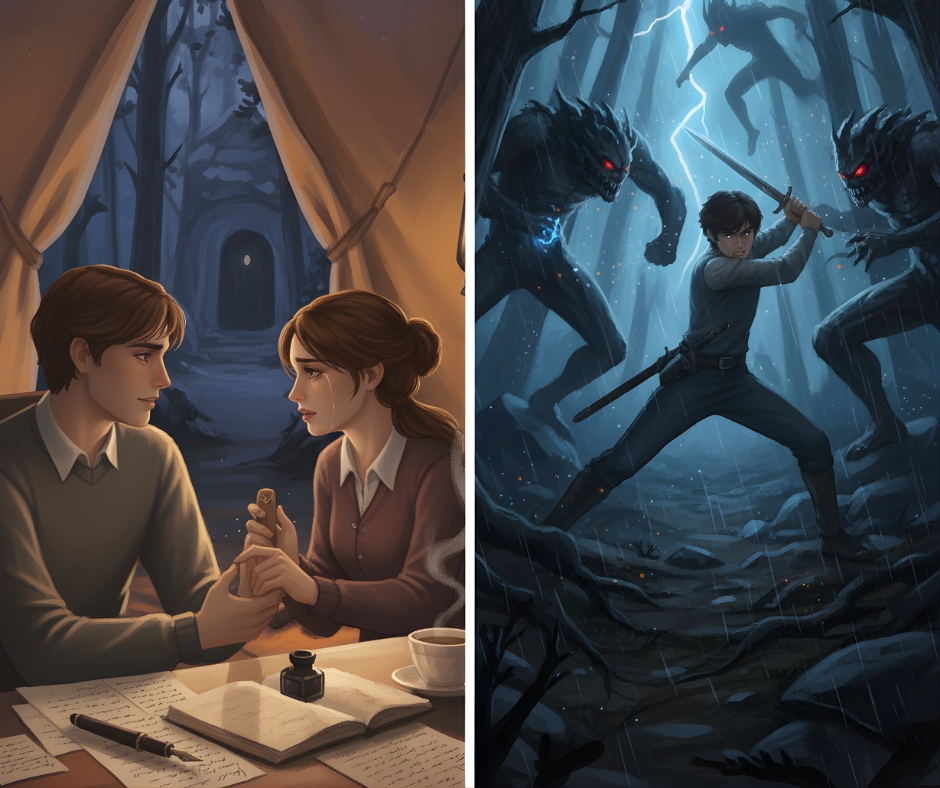
The Quiet Stakes That Make Readers Gasp
Was there ever a time when your story felt… flat? Maybe your story stakes just aren’t landing yet.
Not boring, heaven forbid! But just a little meh, like something important was missing? You’ve got your characters doing things. Big things. Maybe even things that explode. But for some reason, it still doesn’t feel like anything’s really on the line.
Yeah. That might be a “stakes” problem.
And no, we’re not talking about bombs, body counts, or whether the villain is building a death ray on top of a volcano (although solid visual, 10/10). Story stakes are way sneakier than that.
Your Way of Writing Works, And You’re Not Alone
Writers come in all kinds. Some outline every beat, some follow the muse into the fog. Some want slow-burn emotional fallout, while others prefer sword fights at dawn. And every one of those approaches can hit readers right in the feels when the stakes are clear.
If you’ve ever worried that your story isn’t “big” enough, or that it won’t hook readers because it’s not packed with high-octane drama, here’s your permission slip: it doesn’t have to be. Not if the consequences are real to the character.
You might also enjoy Hook, Line, and Sinker: How to Start Your Story Right, which explores how to grab readers emotionally from page one.
Why Consequences Matter More Than Carnage
Here’s the thing: readers care most when characters care most. Story stakes are about significance.
Your main character might not be trying to save the world. They might just be trying to get through a job interview without crying, tell their best friend a hard truth, or avoid going home for the holidays. But if those things matter deeply to them, your readers will feel that tension in their bones.
Stakes = what happens if your character fails + how badly they want to avoid that outcome.
And that “what happens if they fail” should never be just external. It’s not just “they lose the race”. It’s “they lose the race, and now they believe they’re not good enough to try again.”
That’s where your story starts to hit.
Strong story stakes remind readers that something truly matters—emotionally, personally, or spiritually—to your character.
For more insights, see MasterClass: Understanding Conflict and Stakes in Writing.
How to Make Story Stakes Stick (Without Blowing Things Up)
Here are a few ways to raise the stakes in a way that sticks:
- Ask: What does your character stand to lose emotionally? Embarrassment? Trust? Identity? These hit harder than generic peril.
- Make the goal personal. A character who wants to win a tournament is fine. A character who wants to win to prove they’re not just “the forgettable sibling”? Now we’re talking.
- Push them to the edge. If they’re never in danger of failing, it doesn’t matter how much they want something. Don’t be afraid to make them squirm.
- Let failure mean something. If there’s no consequence to losing, then there’s no reason to care whether they win.
Each of these techniques helps you strengthen your story stakes without resorting to explosions or melodrama.
Learn more in Using Emotional Traits in Writing, which shows how character emotion drives story tension.
You can also check Reedsy’s guide on Raising the Stakes for more examples of subtle, character-driven tension.
Go Big or Go True
The goal isn’t to outdo the biggest summer blockbuster. The goal is to make your readers worry.
To make them lean in and say, “Oh no… don’t let this fall apart.”
Whether your climax includes car chases or coffee shop confessions, what really grabs people is the risk of emotional impact.
Big doesn’t mean better. But true? That’s unforgettable.
Continue building authentic tension with The Weight of Silence: How Pauses and Gaps Create Emotional Impact
Want to Play With Story Stakes This Week?
Here’s a fun exercise:
Take a scene from your story where something important happens. Now ask:
- What’s at stake here, really?
- What does my character fear will happen?
- What would it mean to them if it did?
Then, rewrite a small section of the scene so that fear is just a little more present. You don’t need to spell it out, just let it color their choices.
Your readers will feel it.
Final Thoughts
So the next time you’re staring at your plot, wondering if it’s “big enough” to hold a reader’s attention, don’t go hunting for something to explode. Zoom in. Look closer at your story stakes, what your character is afraid to lose, and make that the heartbeat of your story.
Readers don’t need fireworks. They need to feel what’s at stake.
You’ve got this. And if your plot still feels a little wobbly? Don’t worry, we’re just getting started.
Write your book with us
Join the Write Your Books community on Skool. It is free to join, and you get step-by-step help, weekly prompts and other writers cheering you on.
