
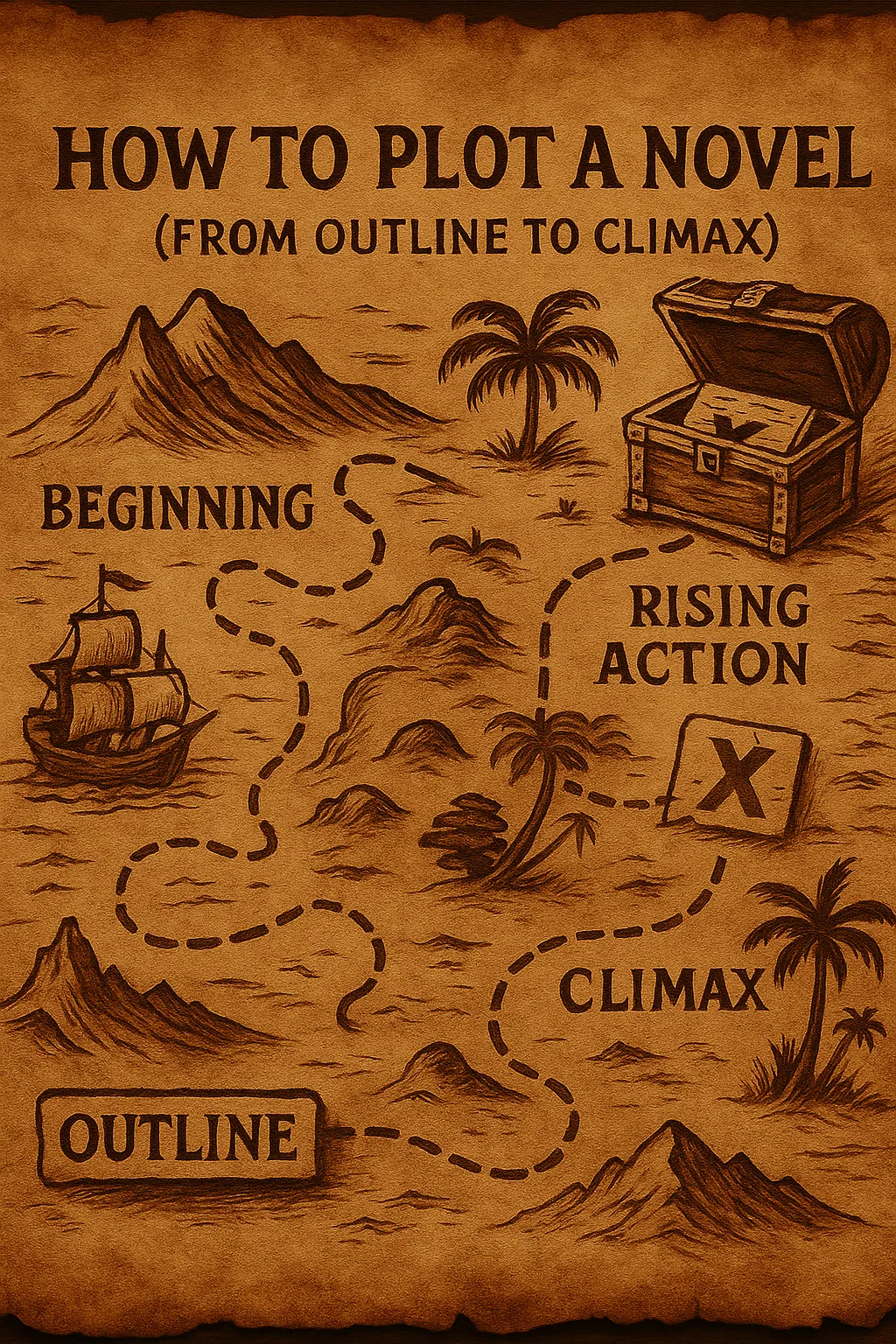
How to Plot a Novel (From Outline to Climax)
Every writer dreams of delivering a story that lands with emotional impact. But a powerful climax doesn’t appear by accident. It’s the product of careful planning, rising tension, and a well-structured outline. If you’ve ever wondered how to plot a novel that truly works, you’re not alone—and you’re in the right place.
In this guide, you’ll learn how to design a flexible, foolproof plot structure that takes your readers on a satisfying journey—from the opening scene to the final page.
📥 Bonus: Grab our free Novel Plotting Template to follow along as you plan!
1. Define Your Story’s Core
Before you write scenes or chapter breaks, establish the heart of your story.
Ask these essential questions:
- What does your protagonist want most?
- Who or what is standing in their way?
- What central tension drives the story forward?
🎯 Example:
In The Hunger Games, Katniss wants to protect her sister (goal), but an authoritarian regime (antagonist) prevents rebellion, setting the central conflict.
When you know what your character wants—and what’s blocking them—you lay the foundation for meaningful conflict.
2. Use the “3‑Act Structure”
One of the most reliable story frameworks is the Three-Act Structure. It gives your novel a beginning, middle, and end—with rising stakes and emotional beats.
First Act: Setup
- Introduce your world, tone, and central characters
- Establish stakes and the protagonist’s normal life
- End with the Inciting Incident —an event that forces change
Second Act: Confrontation
- Obstacles increase; stakes rise
- Introduce allies, enemies, twists
- The Midpoint shifts direction: new knowledge or failure changes everything
Third Act: Climax & Resolution
- Everything converges into a Climax (the final conflict)
- Wrap up with Denouement —emotional payoff, consequences, and change
3. Hit These Key Plot Points on Your Novel Plot Structure
While every story is unique, these structural beats form the skeleton of a compelling plot:
| Plot Point | Purpose |
|---|---|
| Inciting Incident | Launches the story—no going back |
| Plot Point 1 | The protagonist makes a commitment |
| Midpoint | Major twist, discovery, or defeat |
| Plot Point 2 | Final obstacle appears, stakes skyrocket |
| Climax | Emotional and narrative peak |
| Denouement | Aftermath, resolution, and character evolution |
4. Weave in Character Arcs
Plot isn’t just about external events—it’s about how those events shape your protagonist.
💡 At each major beat, ask:
- What is my character learning or resisting?
- How does this challenge their beliefs or desires?
A strong plot and a strong character arc should evolve together. Internal conflict drives external choices—and vice versa.
5. Avoid Common Plot Pitfalls
Keep your structure clean and your story moving by avoiding these frequent mistakes:
- ❌ Plot holes – Make sure each scene logically flows from the last
- ❌ Flat tension – Escalate conflict, don’t let stakes plateau
- ❌ Uneven pacing – Let some scenes breathe, but drive toward your climax
✨ Tip: If your middle feels sluggish, check the midpoint—this is often where momentum needs a boost.
6. Use Our Free Novel Plotting Template
Planning your novel just got easier.
Our free Novel Plotting Template PDF helps you:
- Track plot points and pacing
- Align character growth with story beats
- Diagnose structural problems in any draft stage
Use it to plan from scratch—or revise a stuck draft with clarity.
📥 Download Your Plotting Template
Final Thoughts on Building a Compelling Climax
A novel that works isn’t just about what happens—it’s about how and why things unfold. When you understand how to plot a novel with intention, structure, and emotional rhythm, your story will not only hold together—it will resonate.
Start with a strong foundation, map your beats, challenge your characters, and build toward a climax that earns its payoff. That’s the difference between a book readers like—and a story they’ll never forget.
Ready to dig deeper? Explore our guide on creating unforgettable characters or learn about scene structures that keep readers hooked.
🔗 Related Reading:
- Writing Minor Characters That Steal the Show
- Scene structure strategies
- Blueprints and Breakthroughs: How to Outline a Story Creatively
🚀 Outbound Resource
Write your book with us
Join the Write Your Books community on Skool. It is free to join, and you get step-by-step help, weekly prompts and other writers cheering you on.
